
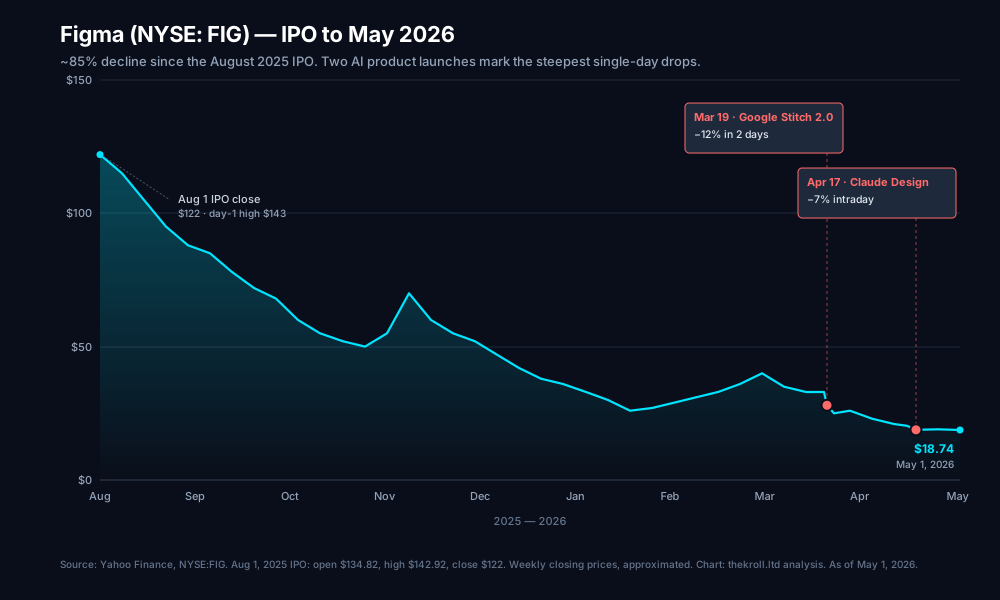
Since its August 2025 IPO, Figma has lost roughly 85% of its market value, dropping from $122 IPO close down to $18.74. The market has been pricing in design-tool disruption for months. On April 17, 2026, Anthropic shipped Claude Design and the stock dropped another 7% in a single session — the second AI-driven single-day crash after Google Stitch 2.0 wiped 12% off in March. The question is no longer whether agents will replace design workflows, but rather how fast this transition will happen.
The Figma Pattern: How AI Agents Reprice SaaS Business Models
Call it the Figma Pattern. The first publicly priced instance of a mechanism that will repeat across SaaS: an AI agent collapses the user-facing layer of a product, and the market reprices the seat-license model within hours. Figma still holds 80–90% percent of the professional UX/UI design market, yet the market repriced it anyway.
What made Figma vulnerable was not weak product. The product was the workflow itself. Designers paid to collaborate inside a canvas. Claude Design produces the output without the canvas, so the surface that justified per-seat pricing dissolves.
Datadog reported their design workflow collapsing from a week to a single conversation, while Brilliant reduced twenty-plus prompts to just two. Mike Krieger resigned from Figma's board on April 14 after reports he would offer a competing product. Three days later, Claude Design shipped.
The signal for your category is identical. Substitute "design canvas" with "sales workflow", "support ticket queue", or "data-entry interface", and you have the next four quarters of SaaS earnings calls. Translated to your P&L: any ARR forecast that still assumes seat-count growth needs to be re-run this quarter.
The product was the workflow itself.
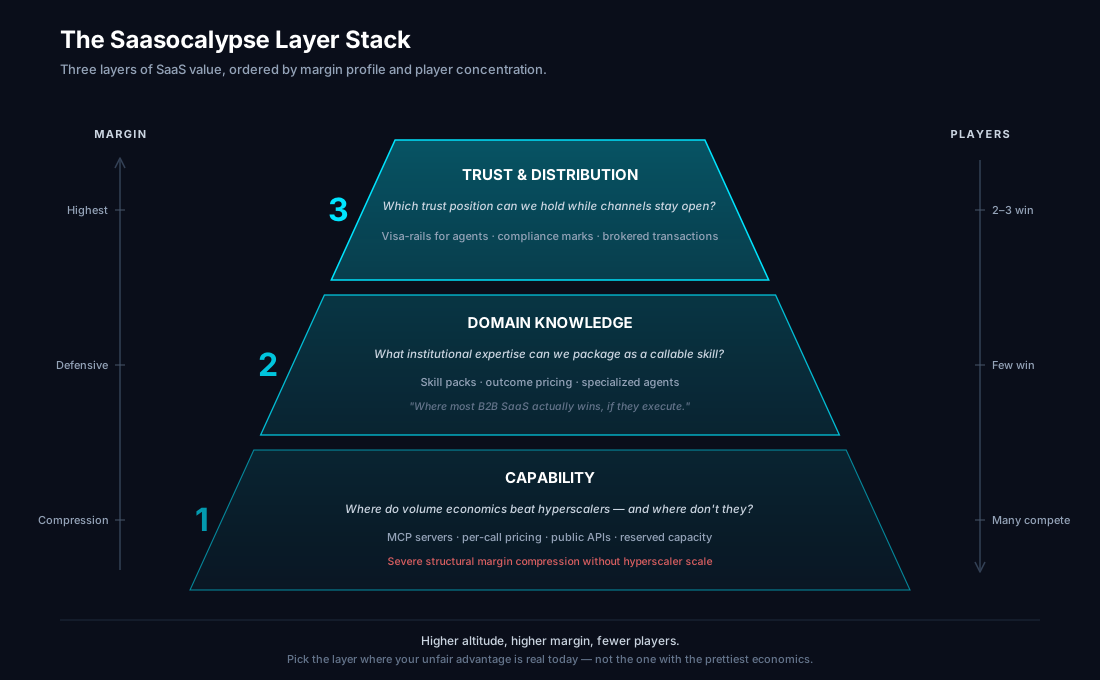
Three Layers of SaaS Value: A Repositioning Framework
Place your product on these three layers — today, and three years out. Each layer answers a distinct strategic question and carries its own margin profile. This is the framework you take into the next board meeting, not a taxonomy.
Layer 1:Capability — Volume Economics and Margin Compression
This is the interface left after the user interface evaporates. The fundamental strategic question here is where volume economics make you competitive against hyperscalers. The agent calls this layer through an API or via MCP, the open protocol that lets agents plug into apps the way USB-C connects hardware.
If your SaaS is a single capability delivered through a user interface, you are heading for this layer whether you planned it or not, much like AWS, Stripe, or SendGrid.
Monetization relies on per-call pricing, per-token models for AI-adjacent capabilities, volume tiers, or reserved-capacity contracts. To survive the margin impact, you need volume combined with operational scale at hyperscaler economics. Anyone else faces severe structural margin compression. Once your product is reduced to a headless API call, you lose the traditional SaaS UI premium and are forced to compete on raw infrastructure economics — a race to the bottom for anyone without hyperscaler scale.
Layer 2:Domain Knowledge — Where B2B SaaS Defends Margin
This is the layer where most current B2B SaaS actually wins, provided they execute. Layer 2 is condensed industry experience — domain knowledge the agent calls when it needs judgment rather than raw capability. You must determine which of your institutional knowledge can be packaged and sold as a callable skill.
Amazon, for instance, leverages 25 years of data on logistics, buyer behavior, and fraud detection. This doesn't live in a simple API; it acts as a sellable skill pack or specialized agent for specific decision classes.
You can monetize this through skill subscriptions, outcome-based pricing based on validated actions, platform licensing, or revenue-share agreements. While margins beat Layer 1 significantly due to the defensive moat of proprietary data, the challenge is actively extracting and packaging that knowledge. Software companies that fail to expose their underlying domain expertise will inevitably get commoditized at Layer 1.
Layer 3:Trust and Distribution — The Two-Player-Wins Layer
This is the brand-and-trust layer that decides which capability or skill the agent recommends when it has options. It operates like Visa and Mastercard, except the rails carry validations instead of card payments. The core strategic decision is which trust position you can hold while agent distribution channels remain negotiable.
Agent providers aren't locked into a single sales channel yet, but that window is closing fast. Just as Google Search monetized placement, agent distribution will follow the same gravity. Monetization involves transaction fees on brokered actions, vetting fees for trusted status, premium placement, or brand royalties, leading to the highest possible margins protected by strong network effects.
However, only two or three players will survive per vertical. The window for establishing this dominance is closing rapidly.
The land grab is happening now, and attempting to enter Layer 3 in 2027 means you are arriving too late.
Which Layer Should Your Company Bet On?
Most current SaaS companies will not win Layer 3. That is not a problem; it is the starting point of a defensible strategy. The pragmatic question is which combination of layers fits your size, your market position, and your unfair advantage today.
The pattern that holds across most SaaS portfolios:
- Horizontal SaaS, under $50M ARR → Layer 1 + Layer 2.
- Vertical SaaS, market leader → Layer 2 + a credible Layer 3 attempt.
- Infrastructure or platform player → Layer 1 doubled down, Layer 2 as margin recovery.
- Sub-scale generalist with no defensible vertical → Layer 1 only, as runway extension.
The reasoning behind these combinations: smaller horizontal players cannot realistically compete for trust positions, so attempting Layer 3 starves the layers where they can win. Vertical leaders have the domain depth that makes Layer 2 defensible and the category position that makes Layer 3 plausible. Infrastructure players already operate at Layer 1 economics. Sub-scale generalists need to use Layer 1 as runway while deciding whether to specialize or sell.
One warning on Layer 3, because self-selection matters. The layer rewards two — maybe three — players per vertical, and being fourth is structurally worse than not entering.
If you cannot articulate in one sentence why your company is one of the two trust positions buyers will accept by 2027, do not spend a quarter chasing it. The opportunity cost is the Layer 2 work you skipped.
The Same Test Applies to Your B2B SaaS: The Salesforce Example
The same three layers apply to your B2B SaaS, with different paint.
Take Salesforce. Today: per-seat licenses for hundreds of sales reps logging in daily. Tomorrow: a single sales agent that updates the CRM, runs forecasts, drafts follow-ups. The per-seat model does not survive that math.
But Salesforce is not dead. Layer 1: raw CRM as an API the agent consumes, priced per call, infrastructure economics. Layer 2: 25 years of sales methodology, vertical templates, Einstein-trained intuition, sold as outcome-based subscriptions to brands that want their agents to actually close deals. Layer 3: Salesforce as the trusted "CRM-of-record" compliance-conscious enterprises insist on, with transaction fees on agent-driven activity.
Same model. Different industry. Same board-level question for the CPO: which layer do we actually have an unfair advantage in?
The pattern repeats. ServiceNow. DocuSign. HubSpot. SAP. Workday. Every B2B SaaS sits on the same three layers, whether they have named them or not.
Amazon's Three Strategic Plays: Fight, Embrace, Pivot
Apply the framework to Amazon and you get three serious responses, not one.
Amazon can fight to defend Layer 3 with their own super-agent like Rufus, betting on staying the default interface. They can monetize Layer 2 by packaging their 25 years of proprietary logistics and buyer data as premium skill packs for other agents. Finally, they can embrace Layer 1 by providing an official MCP server and dominating the underlying physical infrastructure (AWS for physical goods).
Most likely outcome: all three at once, because Amazon is large enough to fund a multi-layer strategy in parallel. Most SaaS companies are not. They have to pick.
If Amazon has to think this hard, and Salesforce has to think this hard, your repositioning question is not whether to act — it is how fast and on which layer.
Proof the Pattern Is Already Running: Anthropic's Layer Play
Anthropic is not just theorizing; they are actively executing in the market.
Claude Design is not a Figma replacement. It is the capability that made Figma necessary, exposed directly. The company building the model that disrupts the SaaS industry chose to first disrupt the tools industry that builds SaaS. Upstream disruption, executed in market.
Generative UI is showing up this year, not next. That is the early read on what happens to every software vertical once the pattern compounds. Design tools first, CRM next, accounting after that. Each compression cycle hits gross margin before it hits revenue.
The companies that pick their layer in 2026 will outperform those that pick in 2027 by an order of magnitude.
What to Do Monday Morning: Three Moves for Leadership Teams
Since reading is comfortable but execution is what actually matters, put these items on your calendar before closing this tab.
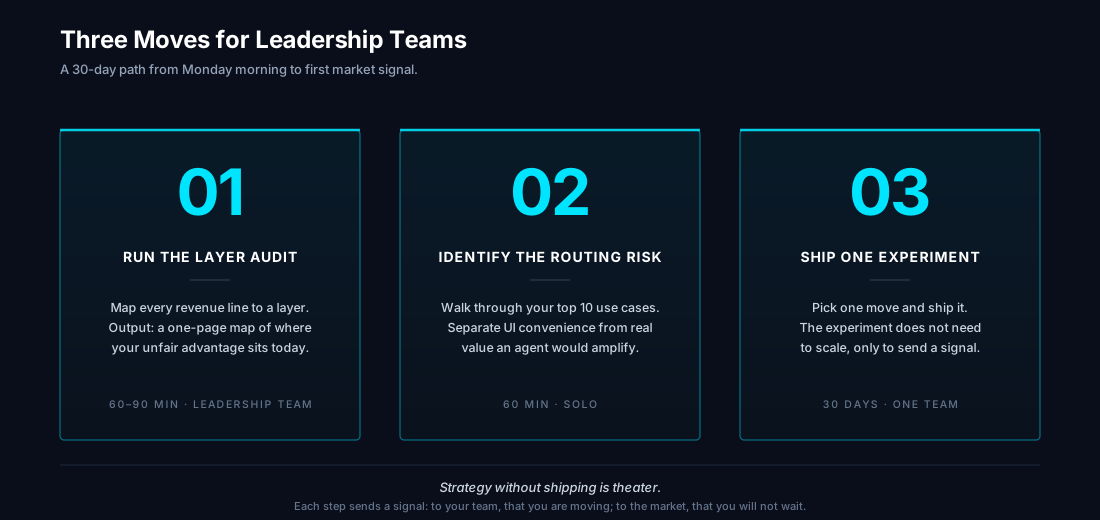
Step 1: Run the Layer Audit (60–90 minutes, leadership team). Map every revenue line and every customer touchpoint to a layer: Capability, Domain Knowledge, Trust. Then be honest about where your unfair advantage actually sits today. Most answers land on something uncomfortable, like "mostly UI convenience and switching costs." That is the starting point, not a problem. Output: a one-page map that tells you which layer turns offensive for you.
Step 2: Identify the Agent-Routing Risk (60 minutes solo). Walk through your top ten customer use cases. For each, ask: what would an agent do tomorrow if it could route around our UI? Which features are UI convenience, and which are real value the agent would amplify rather than bypass?
Step 3: Ship one offensive experiment in 30 days. Because strategy without shipping is merely theater, pick one specific move:
- Layer 1 test: expose one capability as a public MCP server or documented public API.
- Layer 2 test: package a chunk of your domain expertise as a skill pack (even a single GitHub repo counts).
- Layer 3 test: launch a trust signal, compliance mark, or verification partnership in your vertical.
Don't worry about scaling the experiment yet. Its sole purpose is to send a signal—to show your team that you are moving, and to show the market you aren't waiting around.
Technical implementation (exposing capabilities via MCP and packaging skills) will be covered in the companion piece: [coming soon].
The Window Is Open For Now
The saasocalypse will not kill SaaS. It will redistribute its value across three layers, and the companies that pick their layer in 2026 will outperform those that pick in 2027 by an order of magnitude. The window is structural, not cosmetic.
What is the one layer where your company has an unfair advantage today? If the answer is not obvious within 60 minutes of leadership discussion, that is the work for next quarter — not a strategy off-site six months from now.
Want a second pair of eyes on your layer audit before the next board meeting? Book a 30-minute strategy call.